Ab Wheel Training: Perfect Form, Progressions, 3-Day Plan
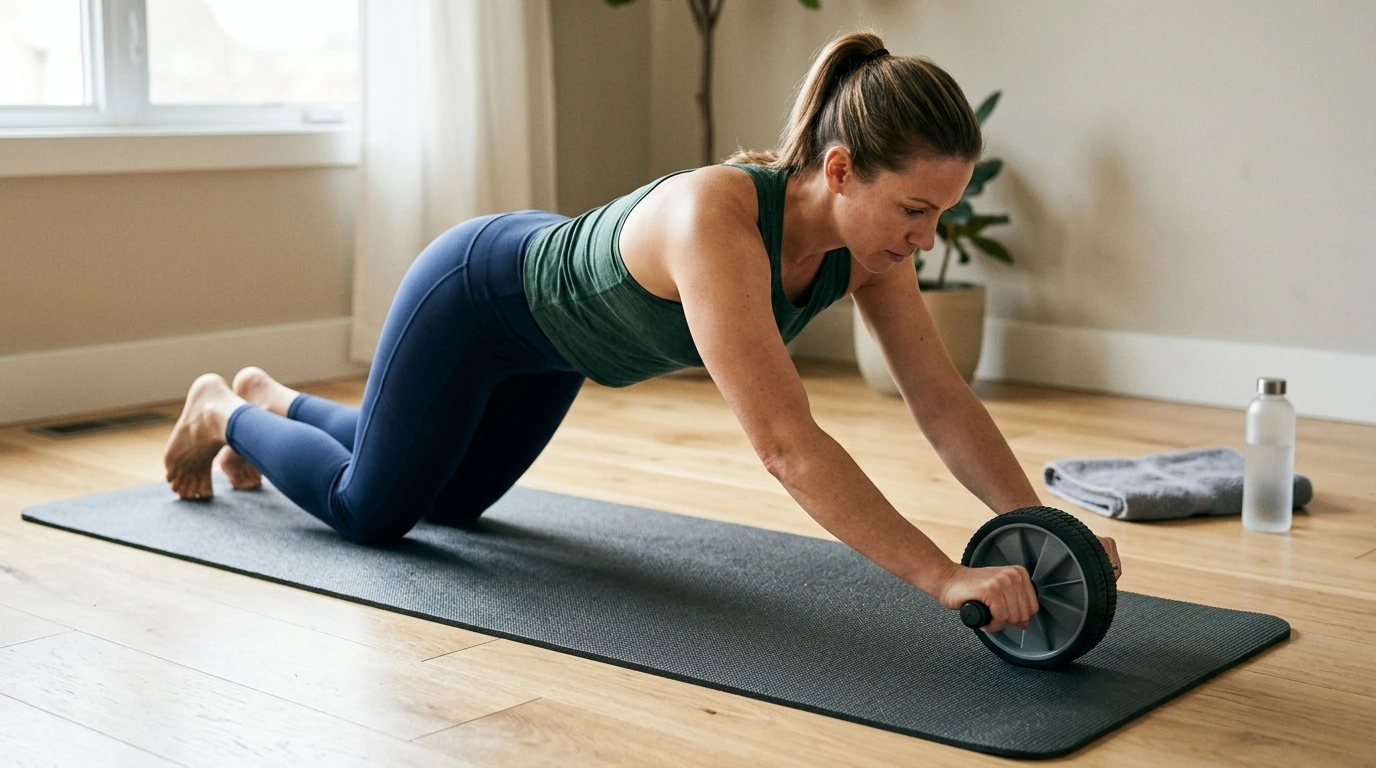
Abdominal Wheel for Strengthening Muscles: Form, Progressions, and a Simple Plan
An abdominal wheel is a compact tool that challenges the core through anti-extension strength—training the abs to resist arching while the shoulders, lats, and glutes stabilize the body. With smart setup and progressions, it can build stronger midsection control with short, repeatable sessions at home.
What the abdominal wheel trains (and why it feels so hard)
Rollouts aren’t “just abs.” Their main job is anti-extension core strength: keeping the ribs down and the pelvis neutral while the wheel moves away from your body. That means your trunk must resist the pull into an arched lower back as the lever arm grows longer.
The key muscles involved include the rectus abdominis (front abs), transverse abdominis (deep core), and obliques, plus major stabilizers like the lats, serratus anterior, shoulders, and glutes. A strong rollout looks like a moving plank: long spine, tight glutes, steady breathing, and a controlled range of motion that never sacrifices position. For general core-training guidance and exercise variations, reputable references include the American Council on Exercise (ACE) and the Mayo Clinic.
Set up for safer rollouts
Start on a non-slip surface so the wheel tracks smoothly without skidding. Use an exercise mat or folded towel to keep your knees comfortable and stable. Grip evenly with wrists as neutral as possible, and avoid letting one shoulder drift forward as you roll.
Before moving, set your spine and pelvis: begin with a gentle “tuck” (slight posterior pelvic tilt), bring your ribs down, and lightly squeeze your glutes. Keep your shoulder blades slightly protracted and “packed”—think “push the floor away” without shrugging into your neck. For breathing and bracing, inhale through the nose before you roll, brace as if preparing for a cough, then exhale slowly as you return. If the low back starts to arch, stop the rep and shorten the range.
| Checkpoint | What to feel | If it goes wrong | Fix |
|---|---|---|---|
| Ribs and pelvis | Ribs down, glutes on | Low back arches | Shorten range; squeeze glutes; start with wall rollouts |
| Shoulders | Stable, not shrugging | Neck tension | Push the floor away; keep gaze slightly ahead of hands |
| Hips | Move as a unit with torso | Hips sag first | Slow down; pause at a shorter distance; add dead bug holds |
| Return phase | Smooth pull back | Yanking or bouncing | Reduce distance; 2–3 second tempo; stop before form breaks |
Progressions that build strength without wrecking form
Progression is less about ego and more about repeating high-quality reps. The simplest way to improve is to control the same position a little farther each week, rather than forcing “full range” immediately.
Beginner options
Wall rollouts are the cleanest starting point. Kneel facing a wall and roll out until the wheel touches it, then return. To progress, move your knees a few inches farther from the wall while keeping the same rib-and-pelvis control.
Partial kneeling rollouts work well if a wall setup is awkward. Roll out only as far as you can keep a neutral spine. A useful rule: stop 2–3 inches before the first sign of form breakdown, then return with control.
Intermediate options
Full kneeling rollouts come next: controlled out and back, with a brief pause at the farthest strong position. The pause exposes whether you’re truly braced or just coasting on momentum.
Eccentric-focused reps build strength fast without forcing the return. Roll out for 3–5 seconds, then drop your knees deeper or reset to come back if needed. This keeps technique crisp while you develop the “braking” strength that protects your lower back.
Advanced options (only after consistent kneeling control)
Elevated kneeling rollouts (hands on a low step) increase range and demand without jumping straight to standing. Standing progressions are best reserved for athletes who can do multiple sets of strict, pain-free kneeling rollouts with no back arching and stable shoulders.
If any step feels shaky, regress intelligently: slower tempo, reduced range, fewer reps, longer rest, or pairing rollouts with easier anti-extension work like planks and dead bugs. For broader strength and conditioning concepts on training progressions, the National Strength and Conditioning Association (NSCA) is a strong reference point.
A simple 3-day weekly plan (10–15 minutes each)
This schedule keeps sessions short while giving you enough weekly practice to improve skill, strength, and control. Stop each set with about 1–2 reps in reserve—clean reps build faster than grindy reps.
Day 1 (technique)
Wall rollouts: 4×6–10
Plank: 3×20–40 seconds
Day 2 (strength)
Day 3 (control)
Who should be cautious (and how to modify)
Using the Abdominal Wheel for Strengthening Muscles
Shop in-stock picks
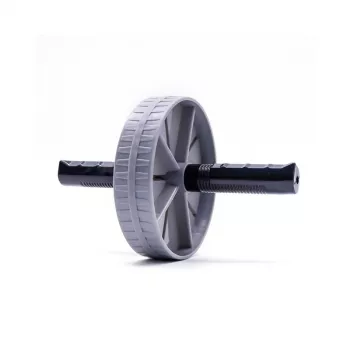
- Abdominal Wheel for Strengthening Muscles — a simple tool for progressive anti-extension training.
- Adidas Women’s White Faux Leather Sneakers — stable everyday sneakers that can work well for light home training sessions.
- Large Pink Heart Makeup Bag — a compact pouch for carrying small workout essentials like hair ties, tape, or earbuds.
| Product | Price | Availability |
|---|---|---|
| Abdominal Wheel for Strengthening Muscles | $5.51 | In stock |
FAQ
How many rollout reps should be done as a beginner?
Start with 3–5 sets of 4–8 wall or partial kneeling rollouts, stopping before the low back arches. Progress by adding a rep per set or increasing distance slightly while keeping the same form.
Why is the lower back feeling tight during rollouts?
That usually happens when ribs and pelvis lose position and the spine drifts into lumbar extension. Shorten the range, squeeze the glutes, brace before rolling, and slow the tempo until you can keep a neutral trunk.
Can an abdominal wheel replace crunches?
It can effectively cover core strengthening through anti-extension, which many people find more transferable to lifting and athletics than high-rep spinal flexion. Pair it with side planks or other anti-rotation work for a more complete core routine.










Leave a comment